← back to clippal
Quick start

Six gestures and you’ve got it

clippal is mostly one panel and a handful of keys. Learn these six and you’ll have covered almost everything you’ll do in a day — the rest is written along the bottom of the panel, where you’ll find it when you need it.

Full reference →

For clippal v1.6.1 Updated August 12, 2026

The panel has three parts

Worth thirty seconds now, because everything else refers back to it.

A schematic of the clippal panel A rounded panel: a search box and a row of filter chips across the top, a list of clip rows filling the middle, and a bar of keyboard hints along the bottom.
  1. Top — the strip

    Search box, then filter chips: what you’re looking at (Archived · Keystrokes · Copied · Notes), then Shortcut, Bookmarked, Tagged and Images, then your tags and apps. Click one to narrow the list, or press ⌥1…⌥9 for the Nth chip — the row below shows which key is which.

  2. Middle — the list

    Your clips, newest first, with the selected one ringed. ↑↓ walks it, ⏎ pastes, ⌘1…⌘9 grabs the Nth without walking there.

  3. Bottom — the hint bar

    The keys available right now — and it changes as you move, so it’s worth a glance whenever you’re unsure. Spelled out further down.

⌥1 … ⌥9 — the chips by position

Hold Option and press a number to flip the Nth chip from the left — no need to walk into the strip first, and it leaves your cursor and your search text alone. Every chip below carries the key it answers to — hover one to see it. clippal does the same, floating the chip’s name and key above it.

Archived , ⌥1 Keystrokes , ⌥2 Copied , ⌥3 Notes , ⌥4 Shortcut , ⌥5 Bookmarked , ⌥6 Tagged , ⌥7 Images , ⌥8 #work , ⌥9 Chrome

The number is a position, not a fixed filter: chips only join the strip once you have a clip of that kind, and your tags shuffle by how recently you used them, so ⌥3 means “the third chip I can see”.

Common flows
01

double-tap Option

Open it

Tap Option twice, quickly, from any app. The panel comes up over whatever you were doing with your whole history in it — start typing to narrow, ↑↓ to walk the list, ⏎ to paste back into the app you came from. Esc closes it. Nothing else needs to be running, and holding Option still works as a normal modifier.

  • If text was selected when you opened it, that text is already in the search box.
  • Prefer a combo? Set one under Settings → Shortcuts and keep both.
More on this →
The clippal search panel over a desktop: a search box, filter chips across the top, a list of clips, and a hint bar along the bottom
02
⌘N

Write a new clip

You don't have to copy something for it to live here. ⌘N opens an empty clip in the preview pane — type a note, a signature, a snippet of boilerplate. Tab moves you Content → Tags → Shortcut, and ⌘S saves. While you're editing, the bottom bar turns into the buttons that matter: Save, Save as new, Discard.

  • The bottom bar is the cheat sheet — it changes with what you're doing (see below).
  • ⌘E does the same thing to a clip that already exists.
More on this →
03
⌘ETabEnter

type a tag, Enter adds it

Tag it, then filter by the tag

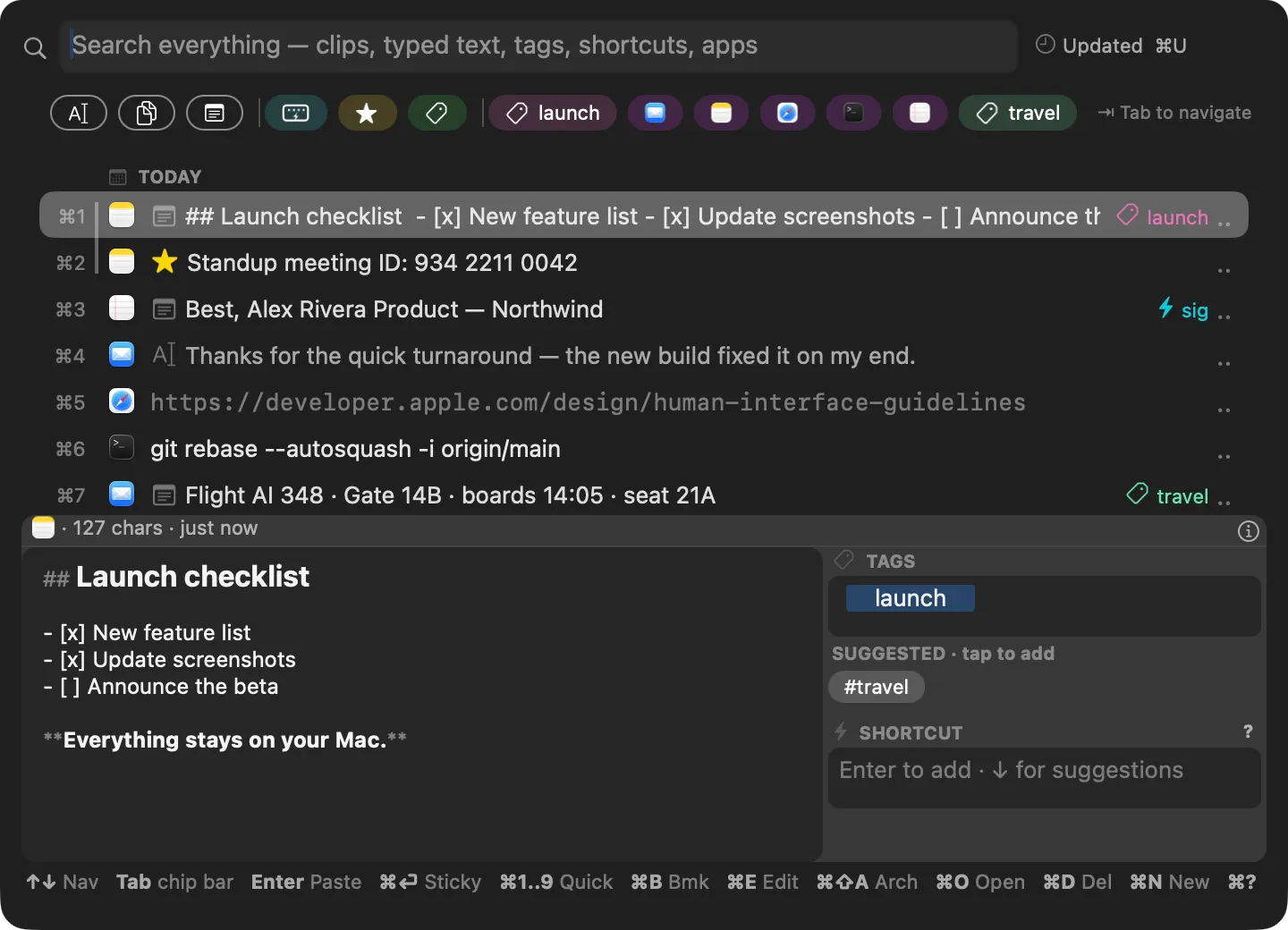
Give a clip tags as you create it, or Tab to the Tags field of any clip and add them. Every tag you use becomes a chip in the strip along the top of the panel: click one — or press ⌥1…⌥9 for the Nth chip — and the list narrows to that tag. Chips stack, so two tags means clips carrying both.

  • A dropdown suggests tags you already use as you type; ↓ on an empty field lists your most-used.
  • ⌫ drops the last filter you added; Esc clears them all.
More on this →
A clip open in clippal: its Tags and Shortcut fields with click-to-add suggestions on the right, and an active green tag chip in the strip above the list
04
;sigspace

type it in any app

Set a shortcut, type it anywhere

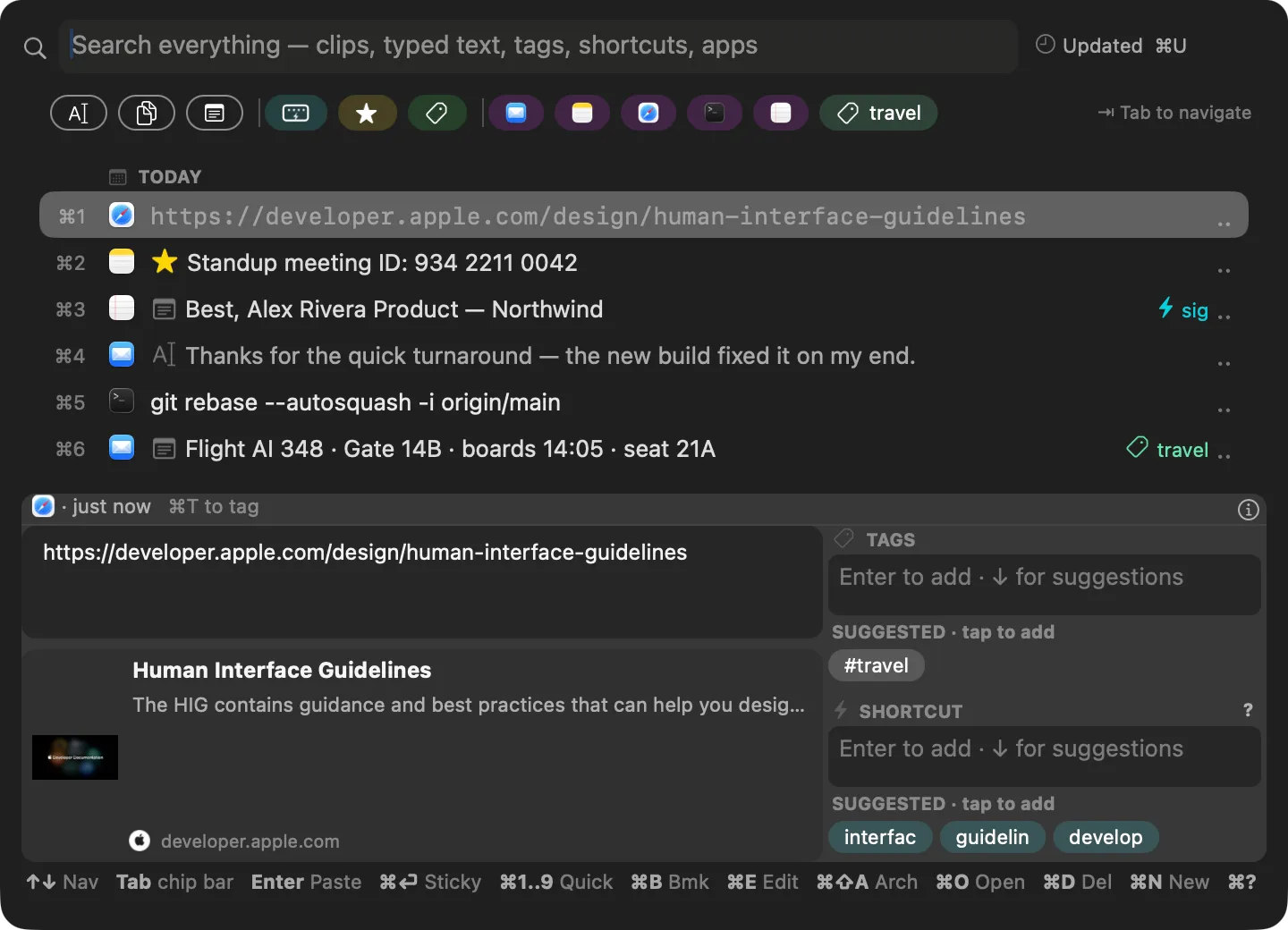
Give a clip a keyword — ;sig, ;addr, whatever you'll remember — and from then on, typing that keyword in any app brings the clip to you. A small picker appears right where you're typing, showing the clip (or clips) behind that keyword; ⏎ inserts the one you pick, Esc leaves what you typed alone. Your clipboard is untouched, so ⌘V still pastes what you last copied.

  • Set it in the Shortcut field of the clip editor — the SUGGESTED pills below the field are click-to-add.
  • Several clips can share one keyword. That's the point of the picker.
More on this →
The clippal shortcut picker floating at the text caret, listing three clips that share the ;sig keyword with the first selected
05
⌘B

Bookmark the ones you keep coming back to

⌘B stars the selected clip. Bookmarked clips get their own group at the top of the menu bar menu, so they're reachable without opening the panel at all, and the Bookmarked chip filters the list down to them. A bookmark is also a promise: bookmarked clips are never cleaned up, however old they get.

  • Same for anything you tagged, gave a shortcut, or wrote in clippal — those are yours to keep.
More on this →
06
drag

grab a row, drop it anywhere

Drag a clip straight into another app

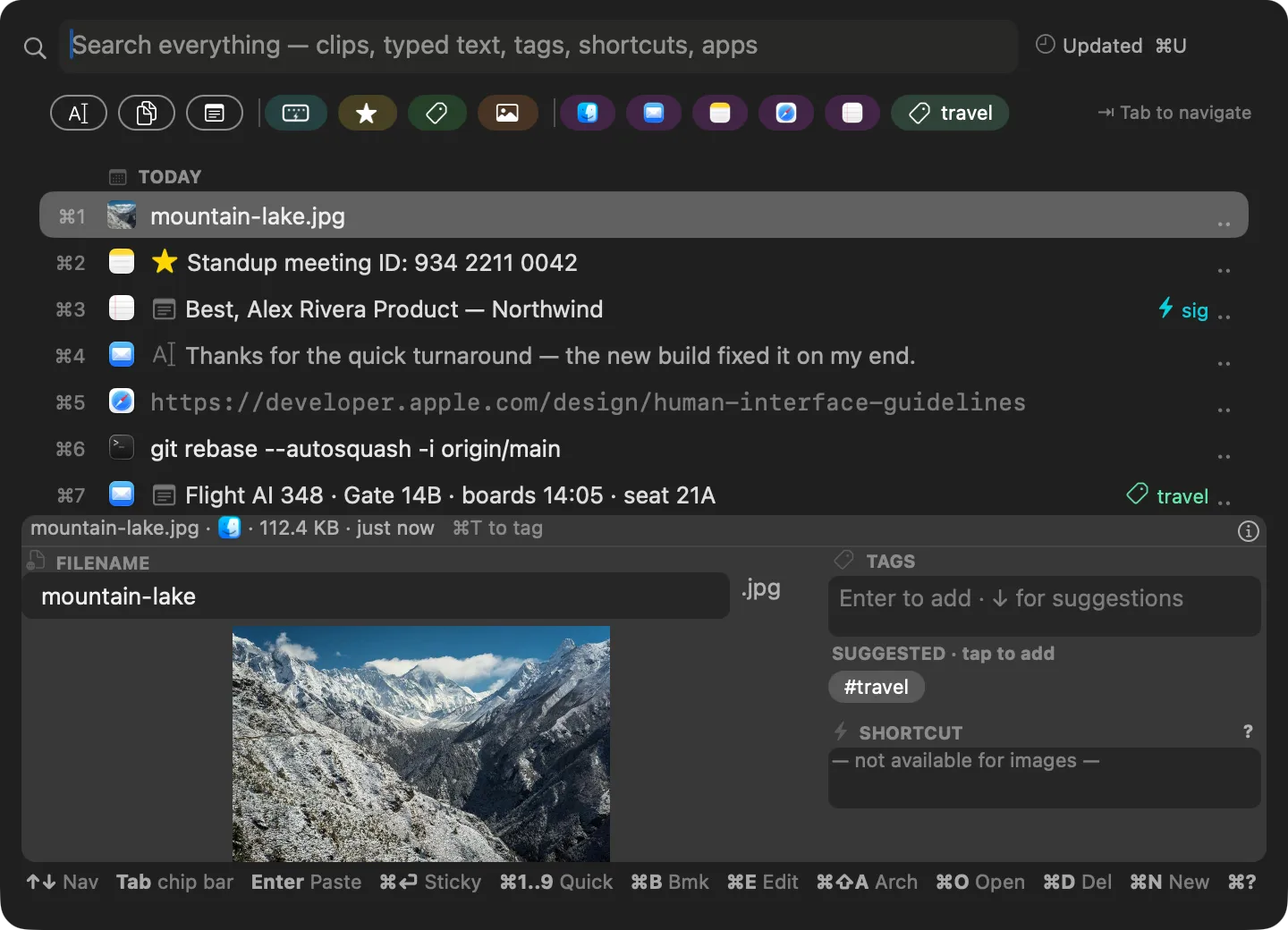
Sometimes pasting isn't what you want. Drag a row out of the panel and drop it where you're headed — a chat box, a document, Finder. Text lands as text; an image lands as an actual file, not a path; a link dropped on a browser's tab bar opens the page. The panel steps aside while you drag and closes once the clip lands, just like a paste. Change your mind mid-air and Esc puts everything back.

  • ⌘-click or ⇧-click a few clips first and they travel as one drag.
More on this →
An image clip selected in clippal, previewed with an editable filename — the kind of clip that drops into another app as a real file
The bottom bar

Everything else is written along the bottom

There’s no shortcut here you have to memorise. The bar under the list always shows the keys that work right now, and it swaps as you move between the search box, the list, the chip strip and the editor. These are the four faces of it.

While you're typing in the search box

Type to search Navigate Tab chip bar ⌘1..9 Quick Paste ⌘N New ⌘? Help Esc Close

With a clip selected in the list

↑↓ Nav Tab chip bar Enter Paste ⌘⏎ Sticky ⌘1..9 Quick ⌘B Bmk ⌘E Edit ⌘⇧A Arch ⌘O Open ⌘D Del ⌘N New ⌘? Help Esc Close

When the cursor is up in the chip strip

← → navigate Enter toggle filter ⌥1..9 toggle Nth list Esc close

While you're editing a clip

⌘S Save ⌘⇧S Save as new Esc Discard

Want the whole map at once? ⌘? opens it inside the panel, and holding ⌘ for a beat pops a card of just the ⌘ actions available in whatever you’re doing.

The top strip

You can see what you typed, too

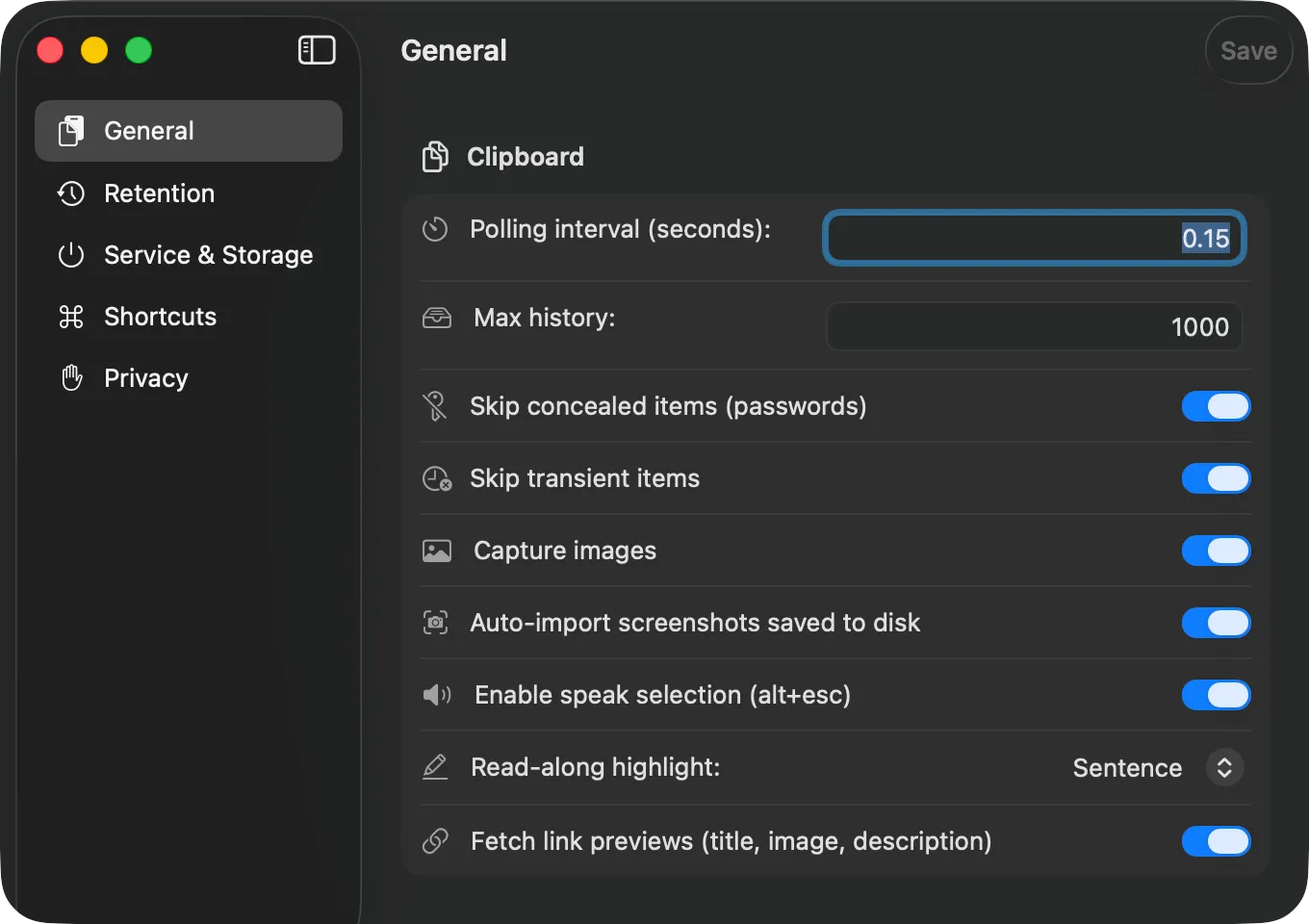
Switch on typed-text capture and clippal keeps the sentences you type, not just what you copy — so the draft that vanished when a page reloaded is still there. It’s off until you turn it on, in Settings → Privacy → Keystrokes, and that pane is where the limits live too: apps and sites to skip, terminals, a minimum length, patterns never to keep.

Once it’s on, typed clips sit in the same list as everything else, marked with a ✎. The chips at the top of the panel are how you separate them from your copies: every clip belongs to exactly one of four slices, and each chip blends its slice in or out. ⌘Y is the quick way to hide or show your typing.

More on this →
The clippal settings window showing the Privacy section, where typed-text capture and its limits are configured
Archived

Things you've put away. Off by default — turn it on to blend them back in.

hidden by default

Keystrokes

What you typed, if you've switched that on. ⌘Y is the quick toggle.

shown by default

Copied

Everything that came off your clipboard — the default reading of "history".

shown by default

Notes

Clips you bookmarked, tagged, gave a shortcut, or wrote here yourself.

shown by default

Peek before you paste
⌥V

Like ⌘V, but you see it first

Hold ⌥V and a small overlay floats what you’re about to paste over your work. Keep holding to cycle back through your history — ⇧ with it goes the other way — and the moment you let go, the clip you landed on is pasted. Same result as ⌘V, minus the guessing about what’s on the clipboard.

One bit of setup: ⌥V ships unbound so it can’t collide with a key you already use. Bind it once under Settings → Shortcuts → “Toggle overlay” — ⌥V is the usual choice — and it works everywhere from then on.

More on this →
Also worth knowing
⌥Esc

Read it aloud

Select text in any app and press ⌥Esc — a window follows along, sentence by sentence, while your Mac reads it.

More →
⌥C

Copy and keep

Copies your selection, bookmarks it, and opens the panel on it, ready to tag or edit.

More →
⌘?

Every key, in the app

The full reference lives inside the panel. Hold ⌘ on its own for a card of just the ⌘ actions.

More →

That’s the working set. When you want the detail — blocking an app, retention, backups, read-aloud controls, troubleshooting — the full reference covers every feature, and you can search it.