Playlist Wrangler
A free extension for Chrome, Edge, and Firefox that organizes any YouTube playlist — search it, auto-tag it, split it, export it. No API keys, no OAuth, no paid tier, and your index lives in your browser, not on a server.
Playlist Wrangler can
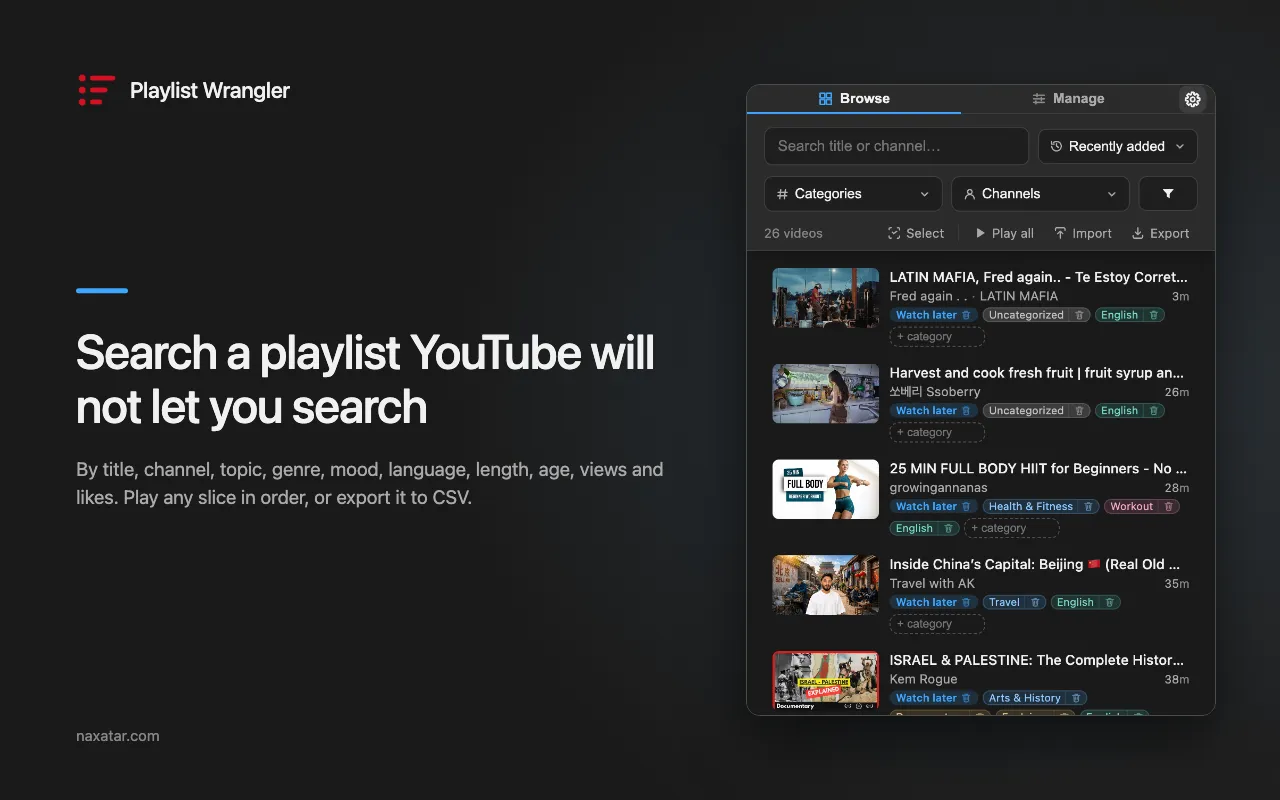
- Search and filter videos across all your playlists
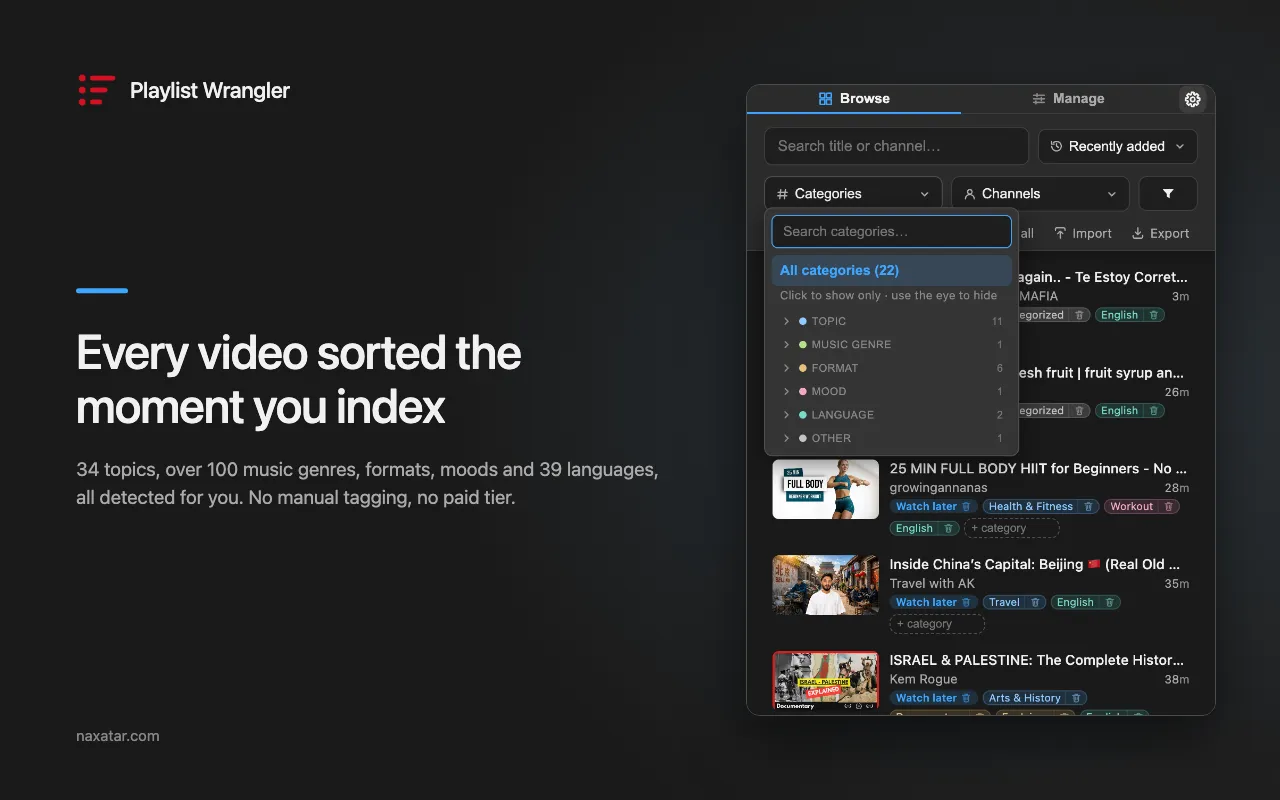
- Automatically categorize every video — topic, genre, mood, language
- Add your own categories on top of the automatic ones
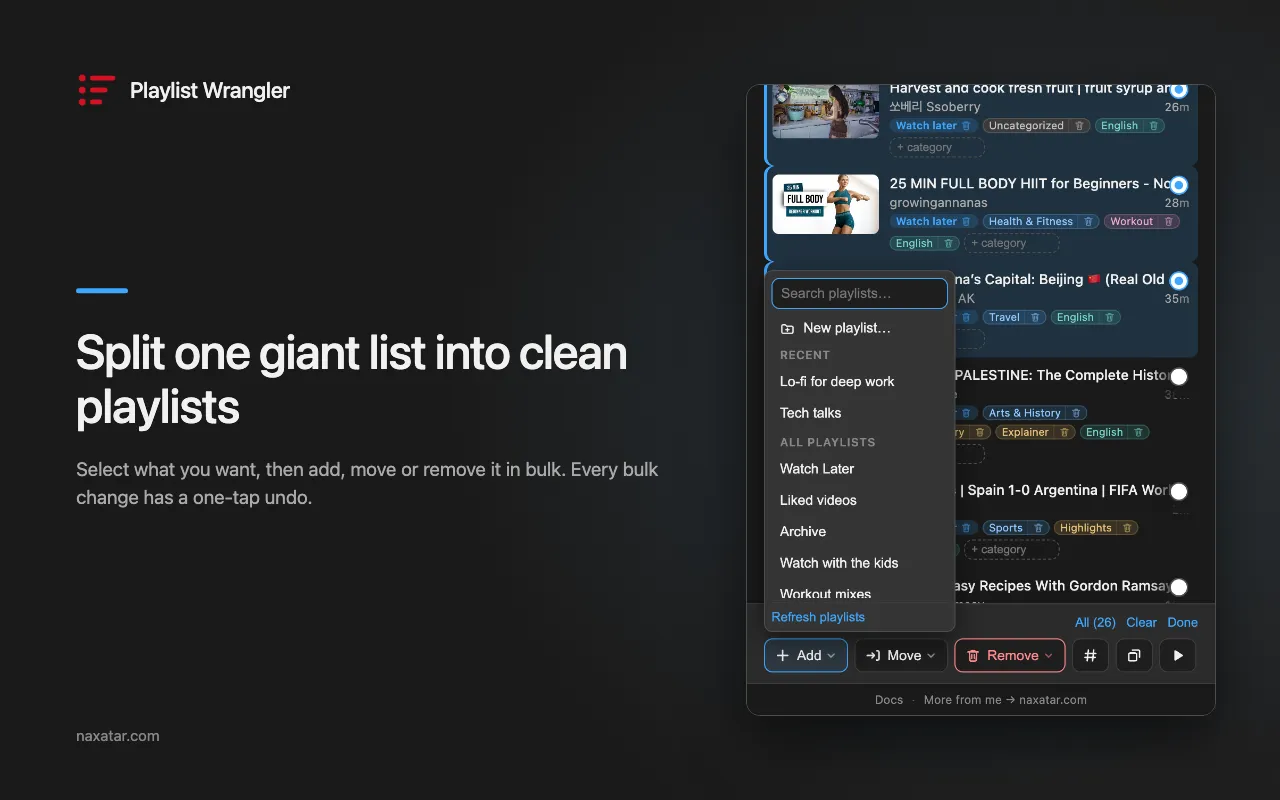
- Bulk add, move, remove, and re-categorize — with one-tap undo
- Split and merge playlists
- Sort by length, views, likes, or age — or shuffle
- Play any filtered set, or your selection in the order you picked it
- Queue videos onto YouTube’s real queue — Play next or Add to queue
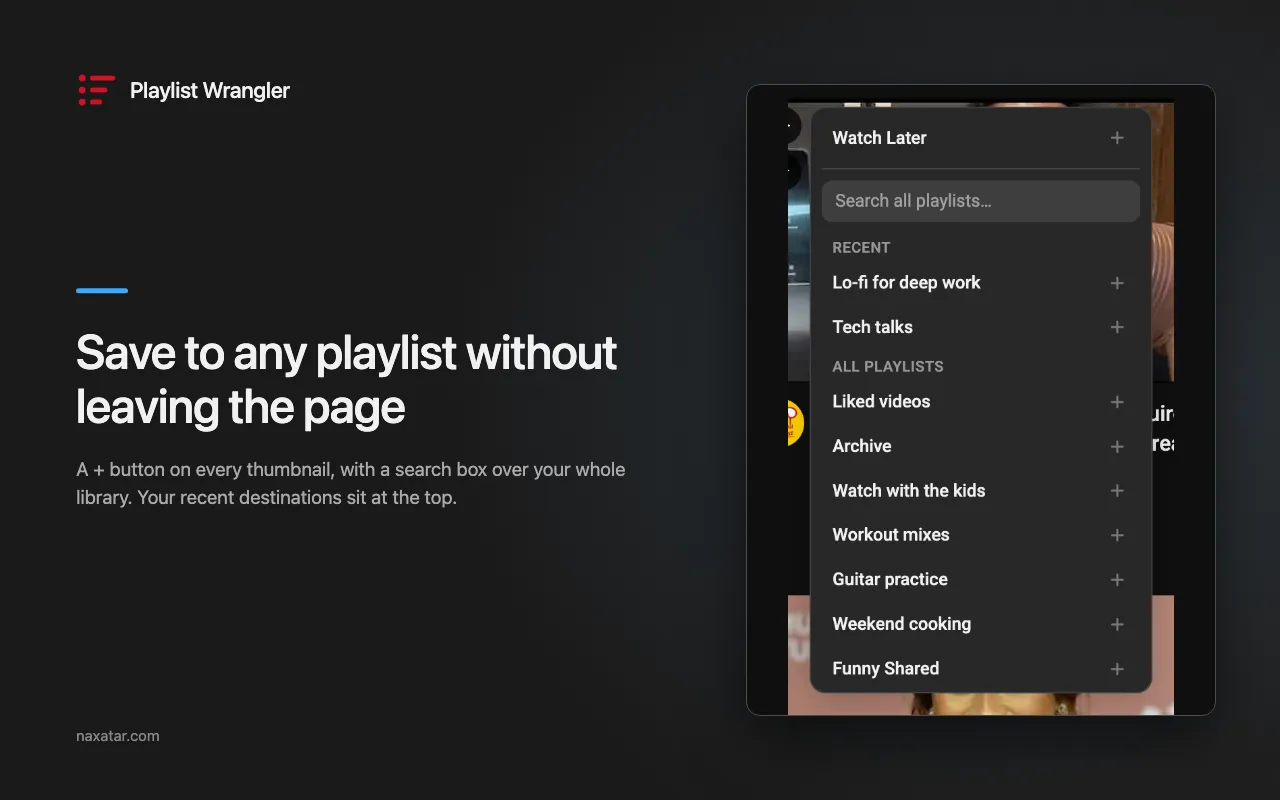
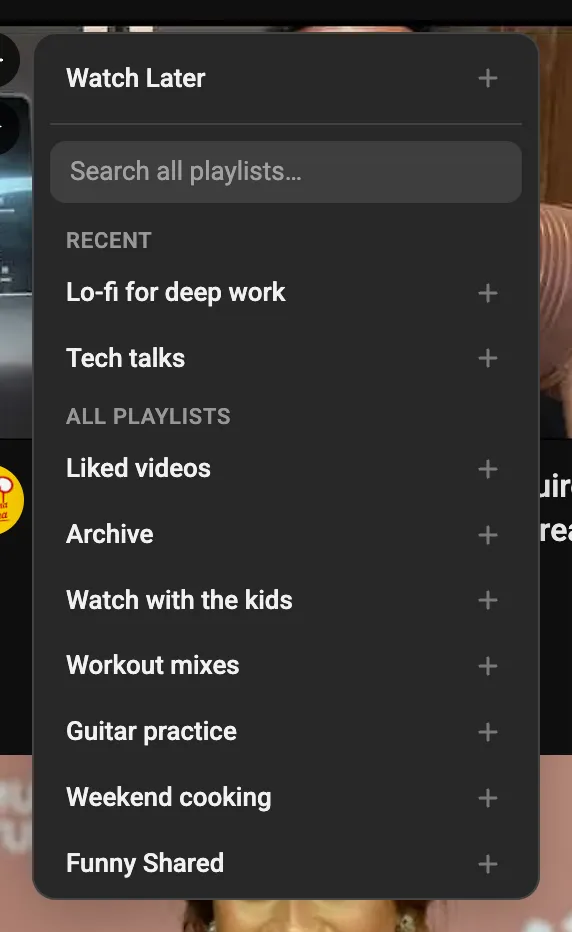
- Save to any playlist straight from a thumbnail
- Import pasted YouTube links or video IDs into a playlist
- Export any view to CSV
- Ask what’s in a video without playing it (beta)
- Auto-sync indexed playlists with YouTube
- Read private and unlisted playlists, Watch Later, and Liked videos
- Show the like-to-view ratio on every video, right in YouTube
- Work across multiple signed-in YouTube accounts
- Deep-scan (optional) for YouTube’s own category, keywords, and exact stats
- Teach you its shortcuts at the moment they’d help — and never twice
- Run with no API keys, no OAuth, and no quotas
- Keep the whole index locally in your browser
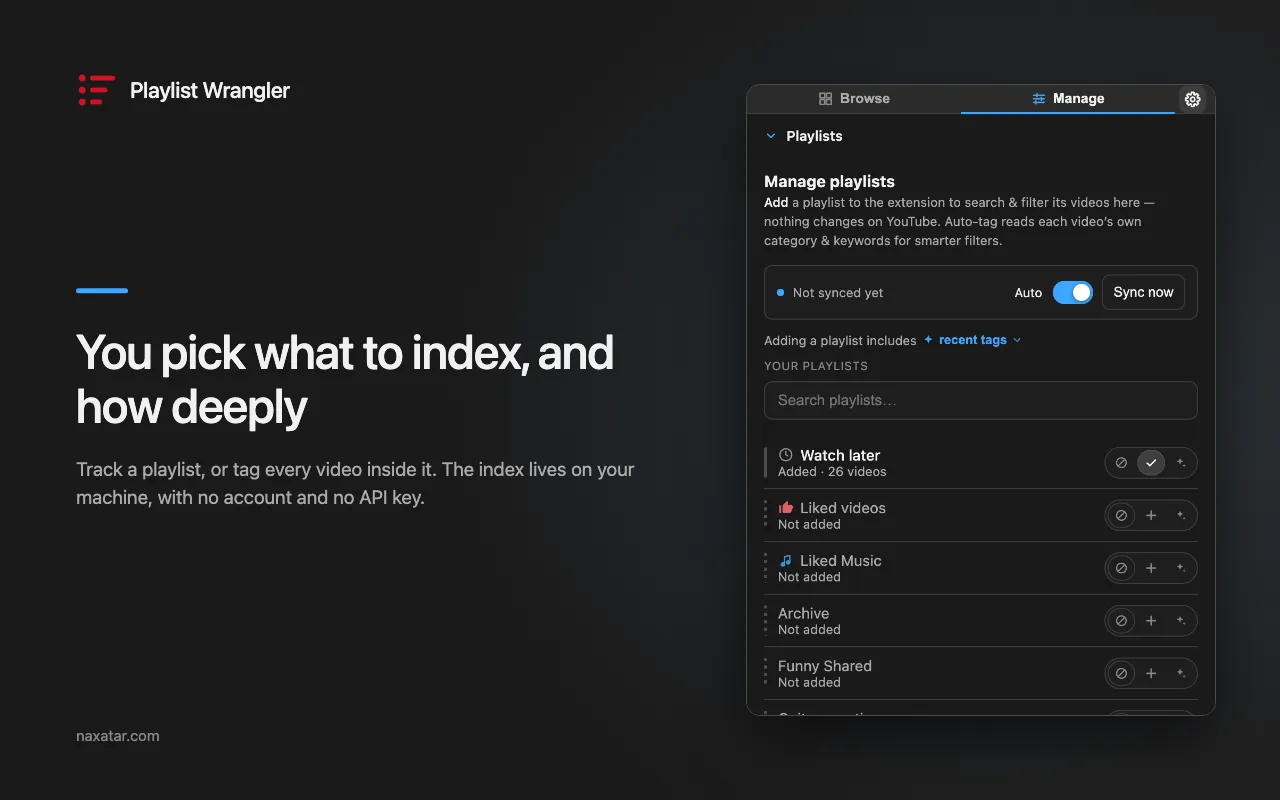
Scroll for more →
✦ New in v1.17.0
- Opera and Arc now get the panel as a window of its own (experimental): neither browser has a side panel for extensions, so instead of a dead-end note the panel opens beside your browser window and remembers itself.
- Select a few videos and press Queue beside Play to stack them onto YouTube’s real queue in the order you picked, after whatever is playing, with a toast that says exactly how many landed.
- Quick Ask answers stay open per video: asking about a second video no longer closes the first, Escape closes them newest first, and the playlist menu can no longer land on top of the button that opened it.
YouTube hands you a playlist, not a way to search it. Past a hundred videos it barely lets you scroll, and the official API means keys, OAuth, and quotas. Playlist Wrangler skips all of that, makes the list findable, and lets you reshape it into playlists you actually use.
52 seconds · Quick Add, Quick Ask, filters, bulk clean-up
What it does
Search and filter that works
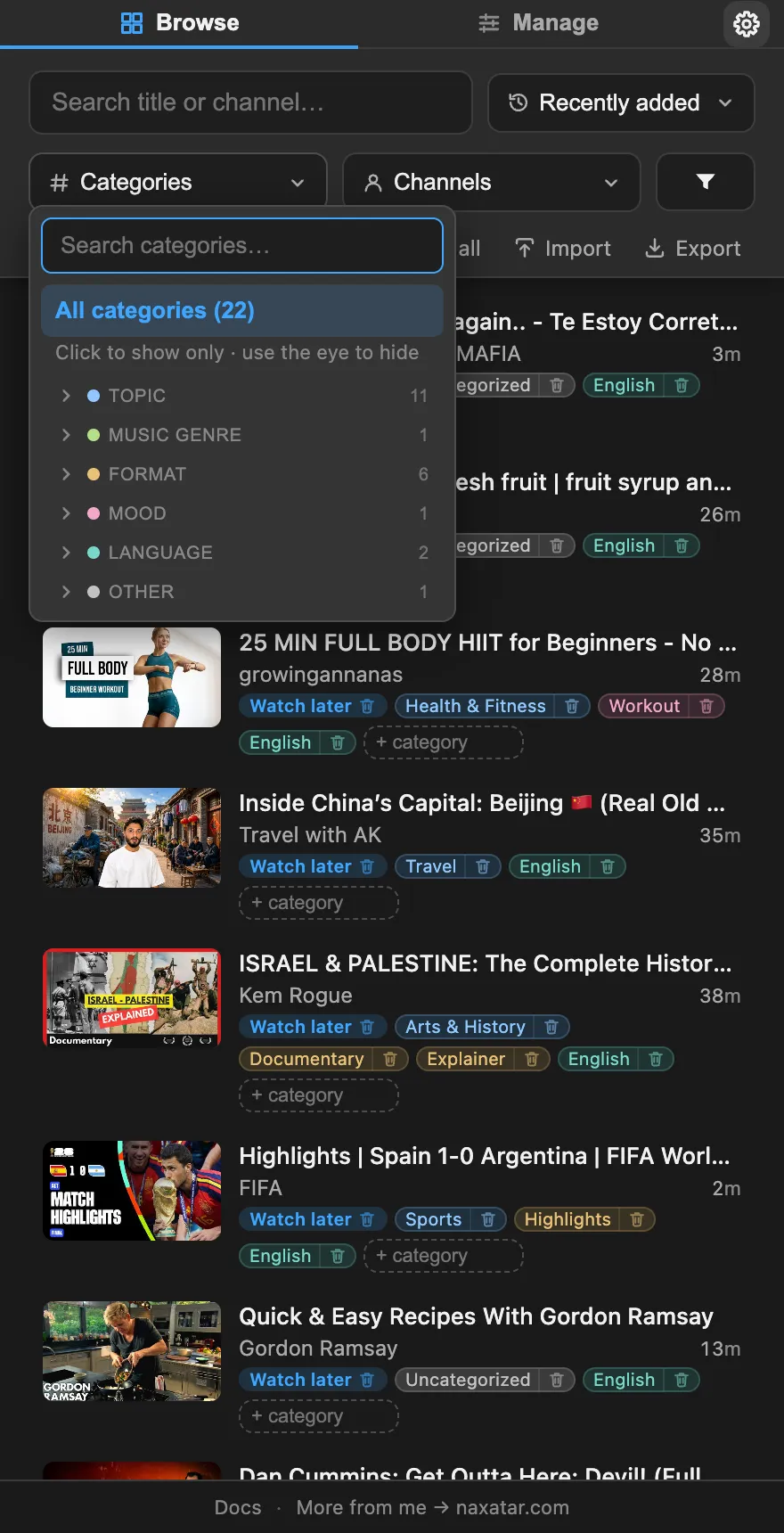
Full-text search across every video, plus filters for category, channel, length, language, age, views, likes, and captions. Each filter leads with the values still present in what you’re looking at.
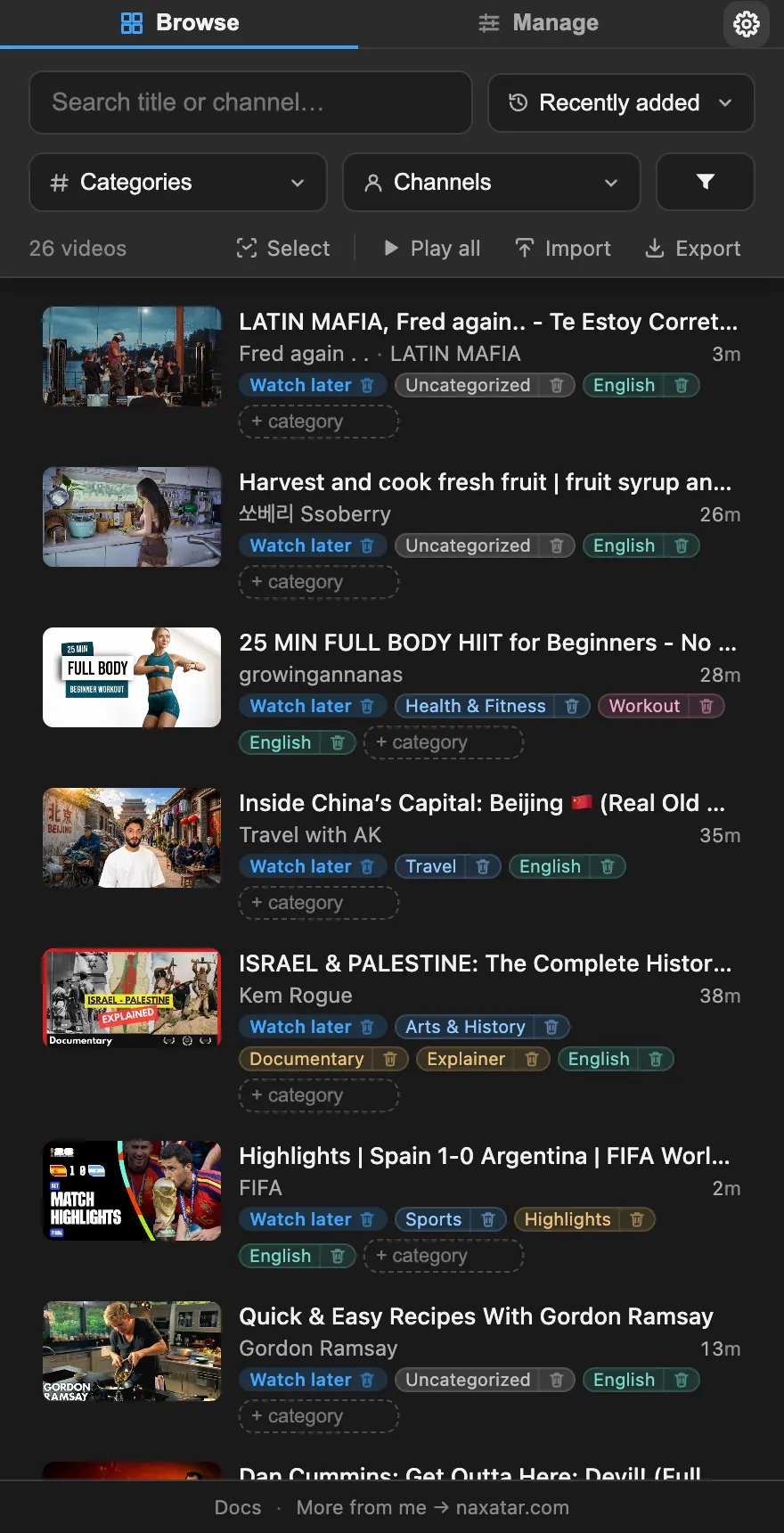
Sorts every video for you, free
The moment a playlist is indexed, every video is sorted across 34 topics, over 100 music genres, film and TV genres, formats, moods, and 39 languages. No labeling, and not a paid upgrade.
Save to any playlist, without leaving the page
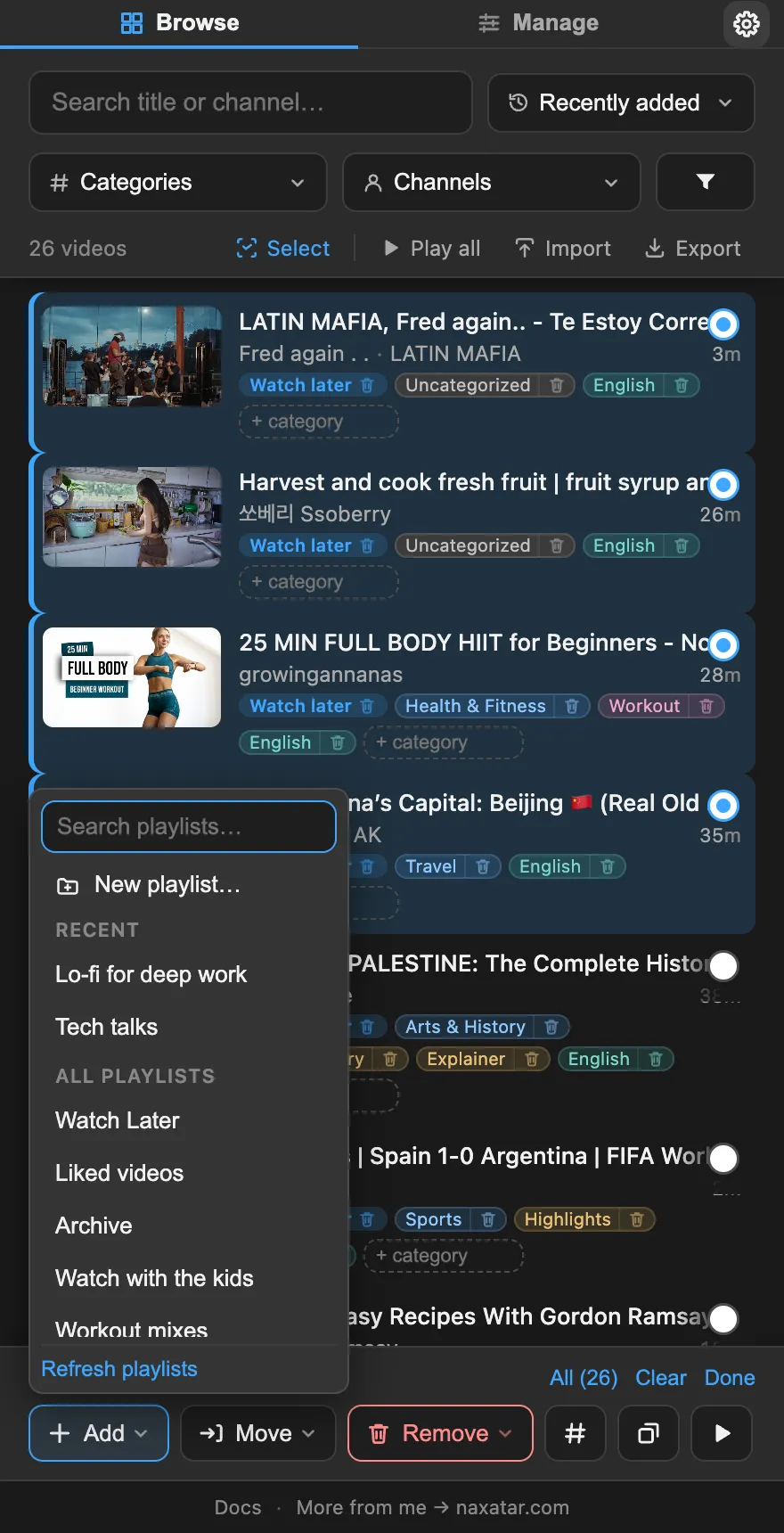
A + button on any thumbnail reaches your whole library through a search box, with recent destinations on top. A ✓ marks what you already have, and clicking it takes the video back out.
Split one list into many
Filter to what belongs together, select the lot, and move it into its own playlist in one step. Every bulk add, remove, or move has a one-tap undo.
No API, no OAuth, no quotas
It reads the playlist from the page you’re already on, riding your own signed-in session. Nothing to authorize.
Works everywhere you do
Private and unlisted playlists, Watch Later, and Liked videos. It reads the whole list, past YouTube’s ~100-video first page.
Play any slice as a playlist
Filter to the set you want, click a video, and it plays in order with autoplay. No playlist to build or clean up.
See how a video landed before you open it
The like-to-view percentage sits inline in YouTube’s own byline, and every panel row carries likes, views, length, and age.
Bring videos in, and take your library out
Paste a list of video links and Import adds them all to the playlist you pick, skipping duplicates. Any view exports to CSV, past YouTube’s 5,000-video Watch Later cap.
Ask what’s in a video without playing it
Quick Ask summarizes from the thumbnail using YouTube’s own Ask AI. In beta, and only on accounts YouTube has given Ask.
Optional deep index
A throttled, resumable pass that pulls YouTube’s own category, the uploader’s keywords, and full stats to sharpen the tagging.
One home for every playlist
A side panel spanning every playlist you’ve indexed, with the same video across lists merged into one row.
- 01
Open a playlist
On any YouTube playlist page, hit the floating button and choose “Scan this playlist.”
- 02
It reads the whole list
The extension pages through the playlist as your own signed-in session — past YouTube’s ~100-video first page — and stores what it read on your machine.
- 03
Search, filter, organize
Search, stack filters, add your own categories. Play a slice in order, or move a batch into its own playlist. Saved locally for next time.
- 04
Go deeper (optional)
Scan every video to add YouTube’s own category, the uploader’s keywords, and full stats, which sharpens the filters.
Everything stays in your browser.
On your machine
The index lives in your browser’s local storage. Your playlists, tags, and metadata never leave your device.
No account, no sign-in
No API keys and nothing to log into. The only thing it sends is anonymous, content-free usage counts.
Only the edits you ask for
It adds, removes, and moves videos when you say so, with undo. It never likes, subscribes, or comments.
Titles first, detail on request
Descriptions and transcripts aren’t part of basic playlist data, so the first pass reads each video’s title and channel. The deep index adds YouTube’s own category, keywords, and exact stats.
YouTube moves, and I follow
It reads YouTube’s live page rather than a stable API, so a big redesign can occasionally call for an update. The parser is built defensively to ride most of them out.
How do I search inside a YouTube playlist?
Can it organize a huge Watch Later?
Can I filter a playlist by genre, mood, or language?
Is there a free extension that automatically tags or categorizes a YouTube playlist?
How do I add a list of video links to a YouTube playlist?
Can I export a YouTube playlist to CSV or Excel?
Can it summarize a YouTube video without playing it?
Can I sort or shuffle a playlist by length, views, or likes?
What is the like-to-view percentage it shows?
Do I need a YouTube or Google API key?
Does it work on private or unlisted playlists?
Where is my data stored?
Can it change anything on my YouTube account?
Is it free?
How is it different from PocketTube?
Which browsers does it work on?
Is there a Firefox version?
Is there a Microsoft Edge version?
Does it work in Arc?
Looking for how-to steps on a specific feature? The searchable docs cover every one.
Found a bug or have an idea?
It goes straight to the maker — one person who builds Playlist Wrangler. No account, no thread to chase.
Organize any YouTube playlist.
Free, private, and it stays out of your way. Pick your browser.
Free and ad-free. If it helps you, you can support the work.